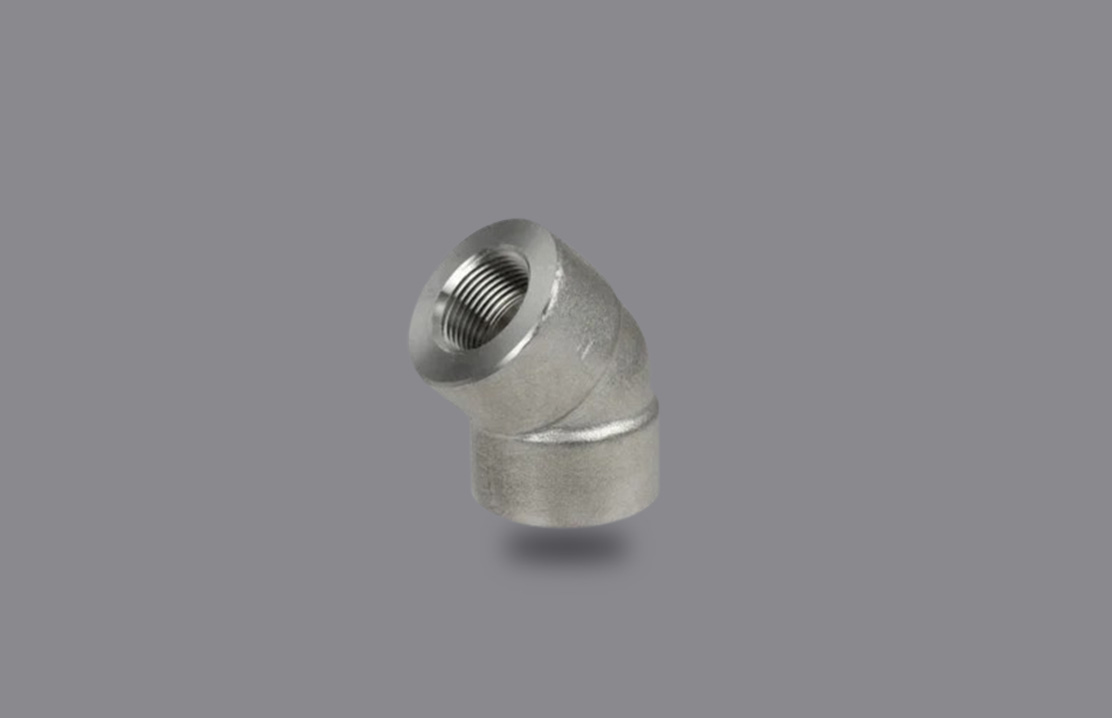
Alloy Steel 45° ELBOW
Home - Alloy Steel - Alloy Steel Forged Fittings - Alloy Steel 45° ELBOW
Alloy Steel 45° ELBOW
When your piping system demands strength, resilience, and the ability to handle harsh conditions, turn to EBY Fasteners’ forged alloy steel 45-degree elbows. These elbows deliver smooth 45-degree directional changes while offering the superior properties of alloy steels – strength, temperature resistance, and the potential to fight corrosion. Choose from a range of alloy grades (low-alloy, stainless, high-alloy) to find the perfect fit for your specific fluids and operating environment
Manufactured to strict ASTM A234 standards, EBY Fasteners’ alloy steel 45-degree elbows ensure accurate dimensions, compatibility with your piping system, and reliable pressure handling. Our quality control processes guarantee that each elbow is built to perform dependably


Select EBY Fasteners’ alloy steel 45-degree elbows for industries like oil and gas, chemical processing, power generation, and any application where standard elbows simply wouldn’t withstand the demands placed on your piping system. Experience the strength and adaptability they provide


Select EBY Fasteners’ alloy steel 45-degree elbows for industries like oil and gas, chemical processing, power generation, and any application where standard elbows simply wouldn’t withstand the demands placed on your piping system. Experience the strength and adaptability they provide
- Low-Alloy Steels (F5, F9, F11, F22) : They offer a good balance of strength, toughness, and modest temperature resistance compared to basic carbon steel. The increasing numbers (F5 to F22) indicate higher amounts of chromium and molybdenum, leading to better handling of higher temperatures and pressures. They're a common choice in oil and gas lines, general process piping, and situations where extreme corrosion isn't a major concern.
- Stainless Steels (F304/304L, F316/316L) : They contain a large amount of chromium, forming a protective oxide layer that resists many chemicals and general corrosion. F304/304L are the most versatile stainless grades, while F316/316L pack additional molybdenum, making them even better at battling pitting corrosion in harsh environments. You'll find these used extensively in chemical processing, food handling, or applications where the fluids could degrade regular steel.
- High-Alloy Steels : This category includes things like duplex and super-duplex stainless steels for extreme corrosion resistance in marine environments, grades with very high chromium for ultra-high temperature service in power plants, and others tailored for very specific combinations of harsh chemicals and temperature. The exact high-alloy grade needed always depends on the precise operating environment the elbow will face
- Standards : (ASTM A234, ASME B16.9, ASME B16.28, MSS SP-75) These act as blueprints for consistency and safety. ASTM A234 covers the alloy steel's composition, while ASME standards define the elbow's dimensions and compatibility with pipes. MSS SP-75 might come in for very specific sizing or material needs.
- Size :(1/2" to 24" NB, Larger sizes may exist) "NB" (Nominal Bore) approximates the pipe's inner diameter. This range suits piping from small process lines to large ones in power plants. Note that very large sizes might need custom fabrication.
- Pressure Rating :(Class 3000, Class 6000, Class 9000) This is the elbow's safety limit – the maximum pressure it handles at a given temperature. Common classes like 3000 cover many uses, but high-pressure industries (like oil and gas) might need higher ratings.
- Elbow Type (45-degree, Long Radius) : This describes the bend. 45-degrees makes a smooth turn, while "Long Radius" (LR) has a gradual curve, which is often better for minimizing flow turbulence inside the pipe.
- End Connections : (Butt-Weld, Socket-Weld, Threaded) This dictates how the elbow joins the pipe. Butt-weld (BW) is common for large, high-pressure lines. Socket-weld (SW) can simplify fit-up, while threaded (TH) is often for smaller sizes and applications where disassembly might be needed
- Strength and Durability : Compared to basic carbon steel, alloy steels offer improved strength, toughness, and the ability to handle higher pressures and temperatures depending on the specific grade.
- Corrosion Resistance : Especially when using stainless steel grades (like F304 or F316) or high-alloy options, 45-degree elbows gain significant resistance to various corrosive environments and chemicals. This is crucial in industries like chemical processing, marine applications, and food handling.
- Adaptability : Alloy steels come in a wide range of grades. This lets you tailor the elbow's properties – strength, temperature tolerance, corrosion resistance – to the specific demands of your piping system.
- Smooth Flow Transition : The 45-degree angle provides a gradual change in direction within your piping. This helps minimize turbulence and pressure drops compared to sharper bends, promoting efficient flow.
- Compatibility with Standards : Manufactured to standards like ASTM and ASME, alloy steel 45-degree elbows ensure precise dimensions, compatibility with pipes and other fittings, and reliable pressure ratings
- Refinery & Petrochemical : Handling various hydrocarbons at different temperatures and pressures calls for robust, potentially corrosion-resistant elbows.
- Chemical : Alloy steels, especially stainless or high-alloys, are crucial in piping systems handling acids, solvents, and other harsh chemicals.
- Oil & Gas : From pipelines to processing systems, alloy steel elbows provide the strength and potential corrosion resistance needed in this demanding sector.
- Power Plant : Depending on the specific area, alloy steel elbows may be needed for handling high-temperature steam lines, cooling water systems, or process piping.
- Offshore Platforms : Saltwater environments demand excellent corrosion resistance, making stainless steel or specialized alloy elbows a necessity.
- Ship Building : Marine applications require corrosion-resistant elbows for various systems, including fuel lines, water systems, and specialized process piping.
- Industrial Machineries : Alloy steels provide durability and may offer corrosion resistance for hydraulic lines, lubrication systems, and process piping within various machines.
- Pharmaceuticals : Stainless steel elbows are often used due to their hygienic properties and resistance to cleaning chemicals and certain process fluids.
- Pumps & Compressor : High pressures and potential vibrations call for the strength and toughness of alloy steel elbows in these systems.
- Dairy & Food : Grades like F304/F316 are common due to their corrosion resistance and ability to withstand frequent cleaning.
- Sugar Mills : Alloy elbows may be used for handling mildly acidic sugar solutions or in areas subject to harsh cleaning environments.
- Textile Machineries : Depending on chemical usage, stainless steel elbows may be needed to ensure contamination-free piping for dyes or other process fluids.
- Fertilizers & Pesticides : Alloy steel elbows might be necessary for handling potentially corrosive chemicals found in these industries
Chemical Composition
| Element | Percentage Range |
|---|---|
| Carbon (C) | 0.08 - 0.30 |
| Manganese (Mn) | 0.30 - 2.00 |
| Silicon (Si) | 0.15 - 0.75 |
| Chromium (Cr) | 0.40 - 20.00 |
| Nickel (Ni) | 0 - 14.00 |
| Molybdenum (Mo) | 0 - 3.00 |
Alloy Steel Forged Fittings
- Alloy Steel 45° ELBOW
- Alloy Steel 90° Elbow & Reducing Elbow
- Alloy Steel Cross Tee
- Alloy Steel Equal Tee
- Alloy Steel Unequal Tee
- Alloy Steel Forged Cap
- Alloy Steel Forged Nipples
- Alloy Steel Forged Union
- Alloy Steel Full/Half & Reducing Coupling
- Alloy Steel Plugs & Bushings
- Alloy Steel Swage Nipples
- Alloy Steel Reducing Insert Fitting
